
TheraSure, computer system validation
Validation for your safety system, drafted by AI and verified by your people.
TheraSure brings computer system validation (CSV) to pharmacovigilance and works alongside the validation system you already own: it grounds every requirement in your User Requirements Specification to its source clause, drafts and runs the test scripts in your safety system with screenshot evidence, and assembles an inspection-ready pack. A person verifies every AI output before it moves on.
- Requirementsgrounded to the source clause
- Test scriptsdepth set by risk
- Run in your systemscreenshot evidence
- Inspection packsigned and traceable
How it works
From your URS to an inspection pack, in five steps a person signs off.
The AI proposes, a person decides, and nothing moves to the next step until it is approved.
Read your URS
Upload the User Requirements Specification you already have. TheraSure extracts each requirement and links it to the clause it came from, with a confidence band for the text, the classification and the regulatory risk. Where it is unsure, it says so instead of guessing.
Approve the requirements
The validator reviews the list, edits where needed and approves it with an electronic signature: printed name, date and time, and the meaning of the signature, with the password entered again.
Draft the test scripts
Scripts are drafted from the approved requirements, with test depth set by risk: scripted testing where failure would matter most, lighter assurance where risk is low. The validator approves each script before it runs.
Run them in your safety system
Approved scripts run in the target system through browser automation. Screenshots are captured as evidence at each step, and each one is recorded in the audit chain. Systems that cannot be automated are run by the validator, who attaches the evidence.
Assemble the inspection pack
One action builds the pack: requirements, scripts, results, embedded evidence, the provenance of every AI-assisted output and the reviewers' signatures. Release needs two different people to sign, and the pack can be verified against the audit chain at any time.
Across the lifecycle
Write the URS, validate the system, and keep it validated as it changes.
The same grounding, the same audit chain and the same rule apply at every stage: the AI proposes and a person decides.
Before
Write the URS
Choose the system, the method and the regulations that apply, answer a short set of intake questions, and the requirements are drafted with a citation on each. Untestable wording is flagged with a rewrite, and a section cannot be signed off while a required area is missing.
During
Validate the system
The five steps above: grounded requirements, risk-based scripts, runs with screenshot evidence, and a signed inspection pack.
After
Keep it validated
Patches, dictionary updates, configuration, interface and access changes and data migrations are each classified by risk, compared with the validated baseline, and the affected tests run again.
See it
The TheraSure application, from portfolio to authoring.
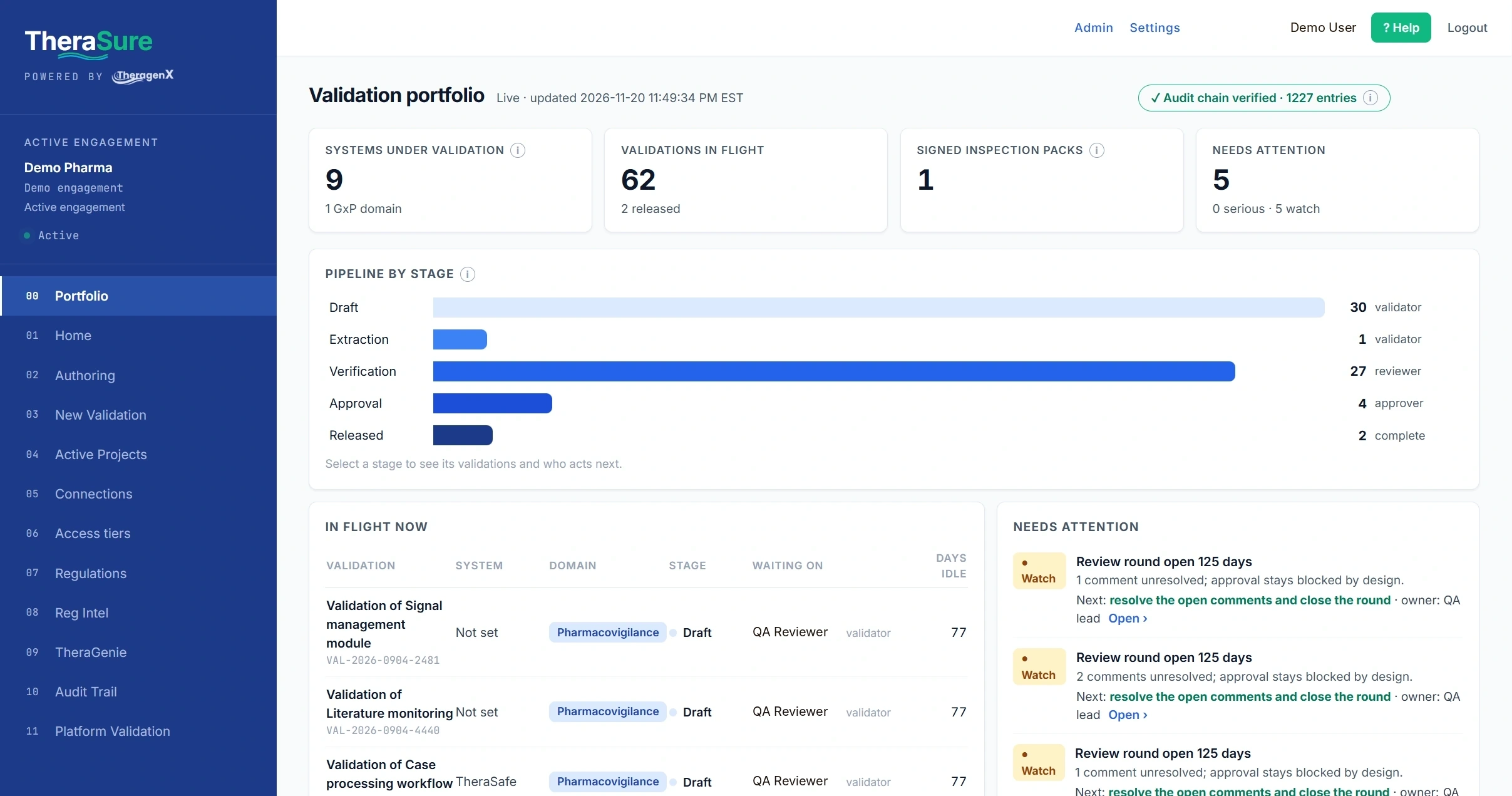
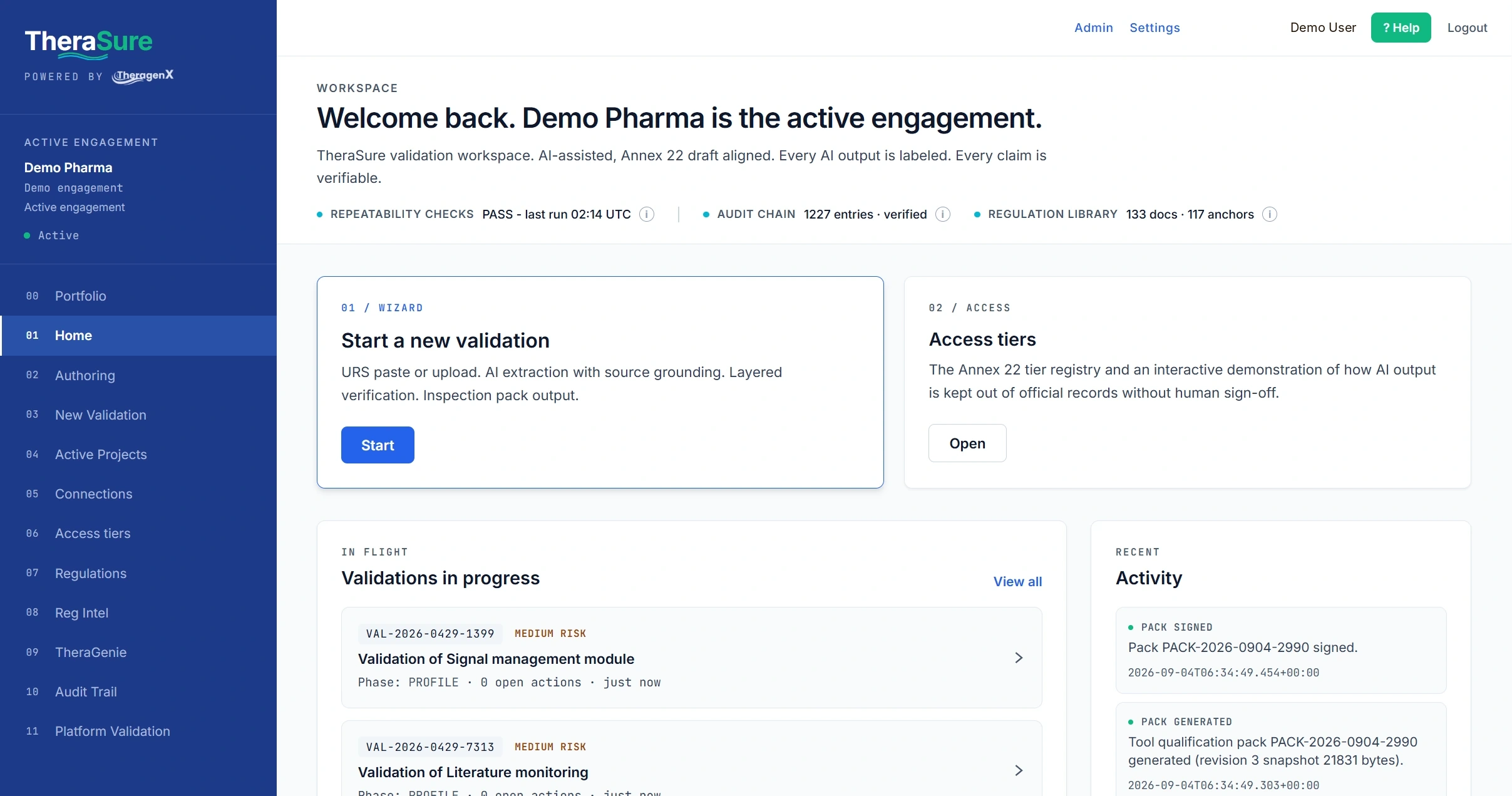
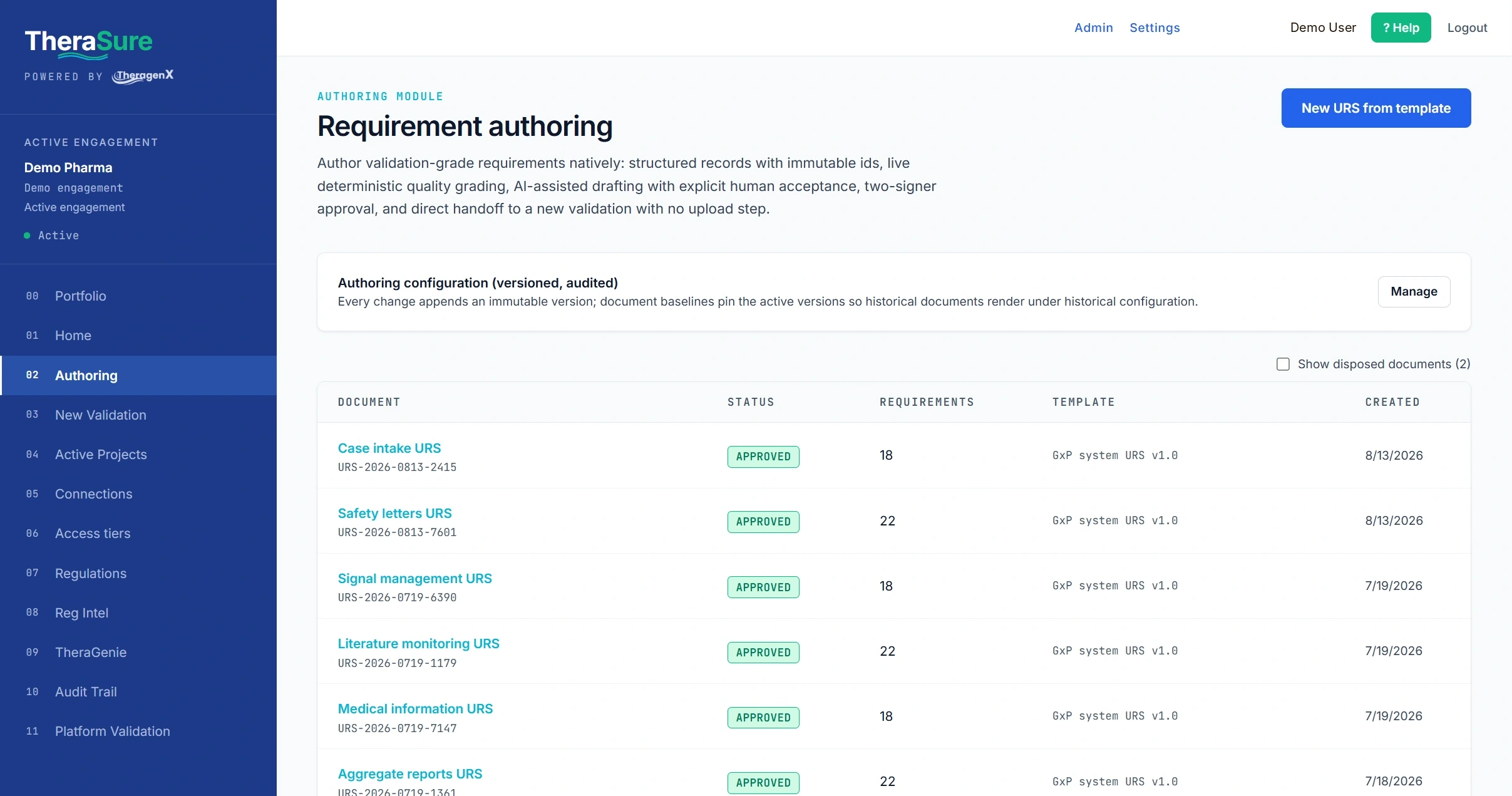
Screens from the TheraSure application, with demonstration data.
Who does what
TheraSure does the labor. Your validation team makes every decision.
TheraSure prepares
- Extracts and groundsEvery requirement linked to its URS clause and to the regulation behind it.
- Drafts and runsTest scripts drafted from approved requirements, run in your system with screenshots.
- AssemblesThe inspection pack, with the provenance of every AI-assisted output.
Your validation team decides
- Approves requirements and scriptsNothing moves to the next step until a person approves it.
- Signs the releaseTwo different people sign, each with password re-entry.
- Stays accountableYour organization remains accountable for the validated state of its systems.
A named, qualified reviewer decides
What leaves
- An inspection-ready packFor your validation file and your inspector.
- Records for your system of recordTheraSure fills the validation system you already own. It does not replace it.
- Scripts in the format you needPrintable, signable documents, or a machine-readable file your own test tools can run.
Which systems
It does not need to know your safety system to validate it.
Tuned support gives the most help on the major safety databases. A guided path handles any other system, including ones TheraSure has never seen, with more of the work checked by a person along the way.
Major safety databases
Tuned support
TheraSure recognizes the structure of URS documents written for the major safety databases and uses tuned extraction for them.
Any other system
The guided universal path
In-house databases, literature, signal and reporting tools: the same steps, with the validator guiding the AI where the system is unfamiliar. It never guesses silently.
Systems that cannot be automated
Manual runs, same evidence
The validator runs the approved script and attaches the screenshots. The audit chain and the pack are the same.
The AI proposes. A person decides. The audit chain remembers both.
Validation is the work a regulator reads most closely. TheraSure takes the repetitive part, and leaves every decision with the people who sign for it.
Built to be inspected
Four controls an inspector can check for themselves.
Designed for 21 CFR Part 11 and EU Annex 11, with risk-based assurance in the GAMP 5 way.
- 01
Grounded in regulation
Answers and drafts are backed by a curated library of regulations and guidance from FDA, EMA, ICH and MHRA, and cite the clause they rely on.
You can checkThe cited clause, one click from the requirement - 02
AI kept out of GxP decisions
Anything that could change a regulated record on its own is handled by fixed, version-pinned rules. Generative AI only drafts, after a suitability check, and its output always needs a person's approval.
You can checkEach component's classification, recorded - 03
A tamper-evident audit chain
Every action, by a person or the AI, is written to an append-only log where each entry is linked to the one before it. Altering any entry breaks the chain, visibly.
You can checkVerify the pack against the chain - 04
Signatures that mean something
Each signature shows the signer's printed name, date and time and meaning, needs the password again, and release needs two different people.
You can check21 CFR 11.50 and 11.200, in the pack
EU GMP Annex 22 on artificial intelligence was published for public consultation in July 2025. The split between fixed rules for GxP decisions and human-verified generative AI is designed against its expectations; compliance is for regulators to judge.
 ISO/IEC 27001:2022Intertek Certification Limited (UKAS 0014)
 ISO 9001:2015Intertek Certification Limited (UKAS 0014)
 SOC 2 Type IIAttestation
Ready for inspection on any day of the year. Designed for 21 CFR Part 11 and EU Annex 11. Validated the GAMP 5 way. The ISO/IEC 27001:2022 and ISO 9001:2015 certificates are in the Trust Center. SOC 2 Type II attestation: the full report follows a call and a mutual NDA.
AI model governance
AI model governance and validation.
The AI inside a safety system is validated like the rest of it, and stays validated as it changes.
- 01
Intended use and risk
Each AI component's purpose, the decisions it touches and its risk are recorded before any testing.
- 02
Qualified test data
The data used to test it is checked for coverage and quality, and documented.
- 03
Benchmarks with pass marks
Performance is measured against thresholds agreed in advance, and the evidence goes into the pack.
- 04
Locked versions
The model version is fixed for every run. Any update is a controlled change.
- 05
Drift monitoring
Live performance is watched against the pass marks, so a decline is seen early.
- 06
Revalidation triggers
A model update, new data or a drop in performance reruns the affected tests.
- 07
Human oversight
A named, qualified person approves each result. The AI never signs.
Designed for FDA 21 CFR Part 11 and EU Annex 11 and validated the GAMP 5 way, with FDA guidance on AI that supports regulatory decisions, the EU AI Act and EU GMP Annex 22 in view.
Where it connects
One validation story across the platform.
Questions
What validation leads ask.
Questions about hosting and training data are answered once, in the Trust Center.
Does TheraSure replace our validation system?
No. Your validation system stays the system of record. TheraSure does the work that fills it: extraction, scripts, runs, evidence and the pack.
Does it replace our validation team?
No. Your team approves every requirement and script, signs the release and remains accountable for the validated state. TheraSure removes the repetitive labor.
Which safety systems can it validate?
The major safety databases, with tuned support, and any other system through the guided universal path, including in-house systems it has never seen.
Can the AI approve or change anything on its own?
No. Every AI output is verified by a person before it moves on. Anything that could change a regulated record on its own is handled by fixed rules, never by generative AI.
What will an inspector see?
For any requirement: its URS clause, the regulation it relies on, its script, the run with screenshots, any deviation, and the signatures, all verifiable against the audit chain.
Can TheraSure write our URS?
Yes. TheraSure Lifecycle drafts the URS with you: every requirement cites the regulation or the interview answer behind it, untestable wording is flagged with a suggested rewrite, and a section cannot be signed off while a required area is missing. Or start from the URS you already have.
Can we run the scripts with our own test tools?
Yes. Scripts export as printable documents with a signature block and provenance, and as a machine-readable file your own automation tools can run. Either way the provenance travels with the script.
Request a demo
Bring one section of your URS.
We will extract and ground its requirements, draft the scripts and show the pack while your validation lead watches.
- A session with our Quality and validation team
- Your own URS section, or a sample one
- A reply within one business day