TheraQ, quality management system (eQMS)
One quality system for every GxP function, led by risk.
- Audit first by risk. A heat map ranks every vendor, site and team, and shows why.
- Scores you can check. Each vendor score is built rule by rule.
TheraQ is a quality management system for life sciences (eQMS): documents, training, deviations, CAPA, change control, risk, audits and inspections, for every GxP function and its vendors. Pharmacovigilance compliance is built in.
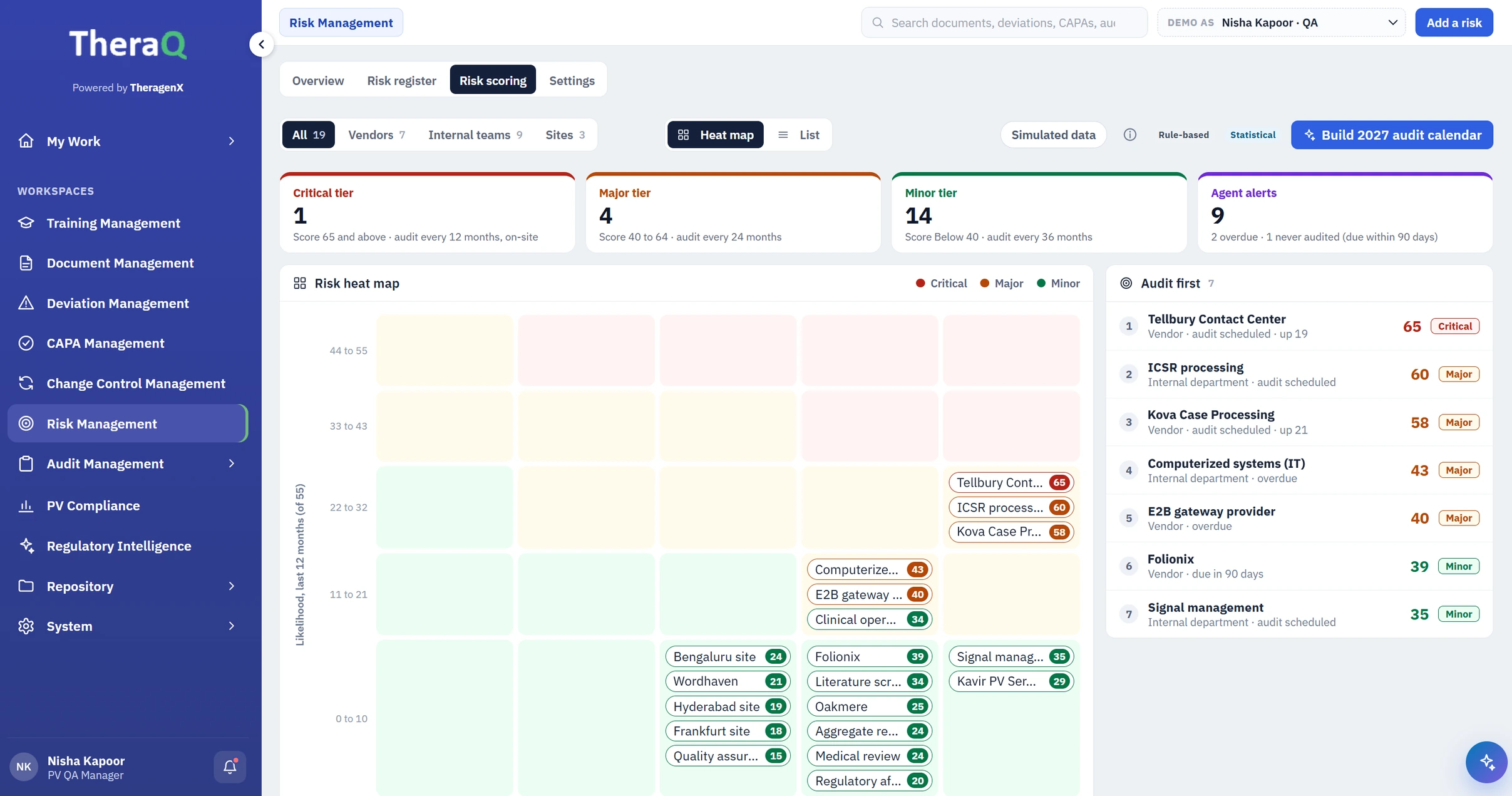
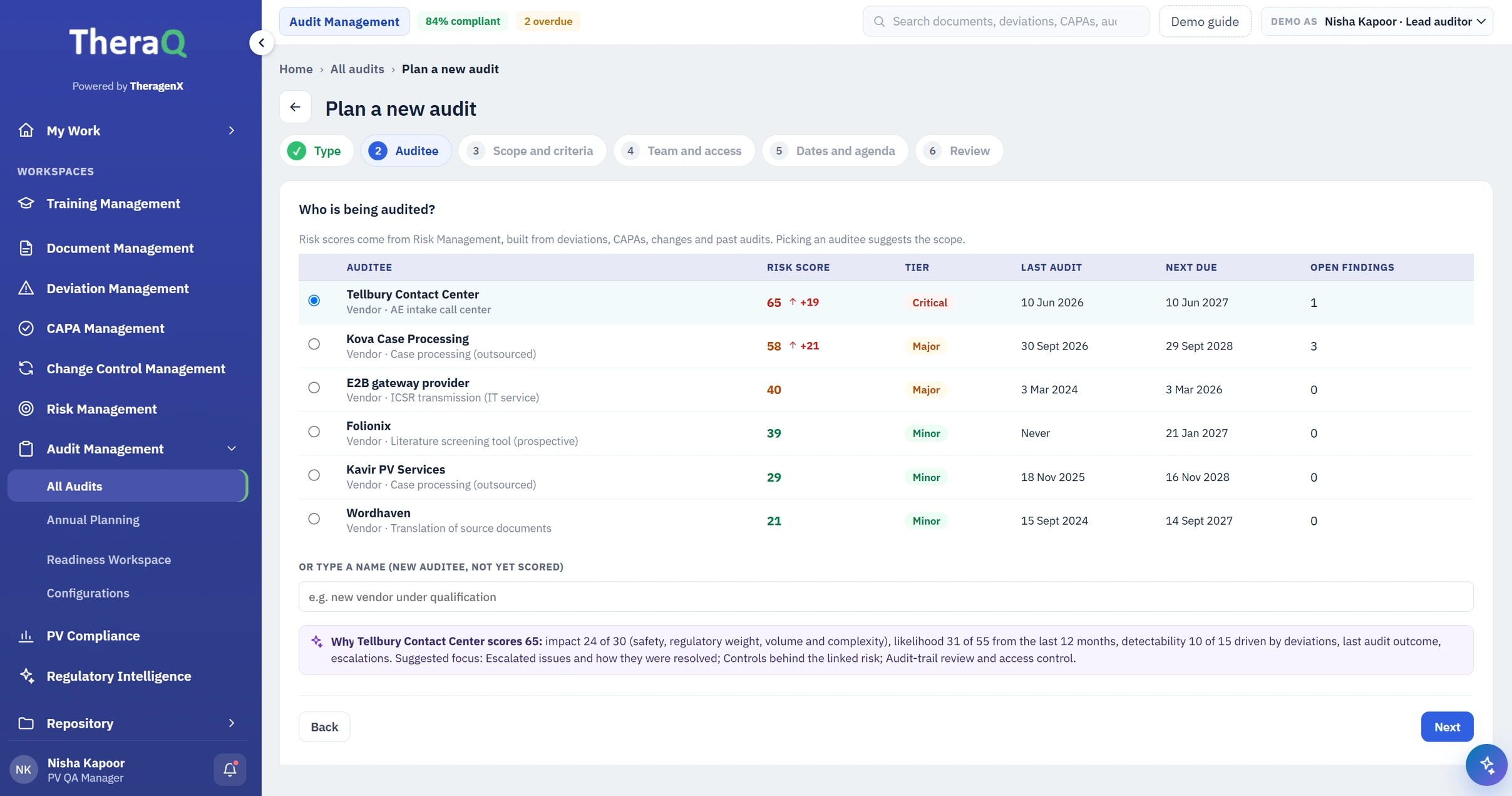


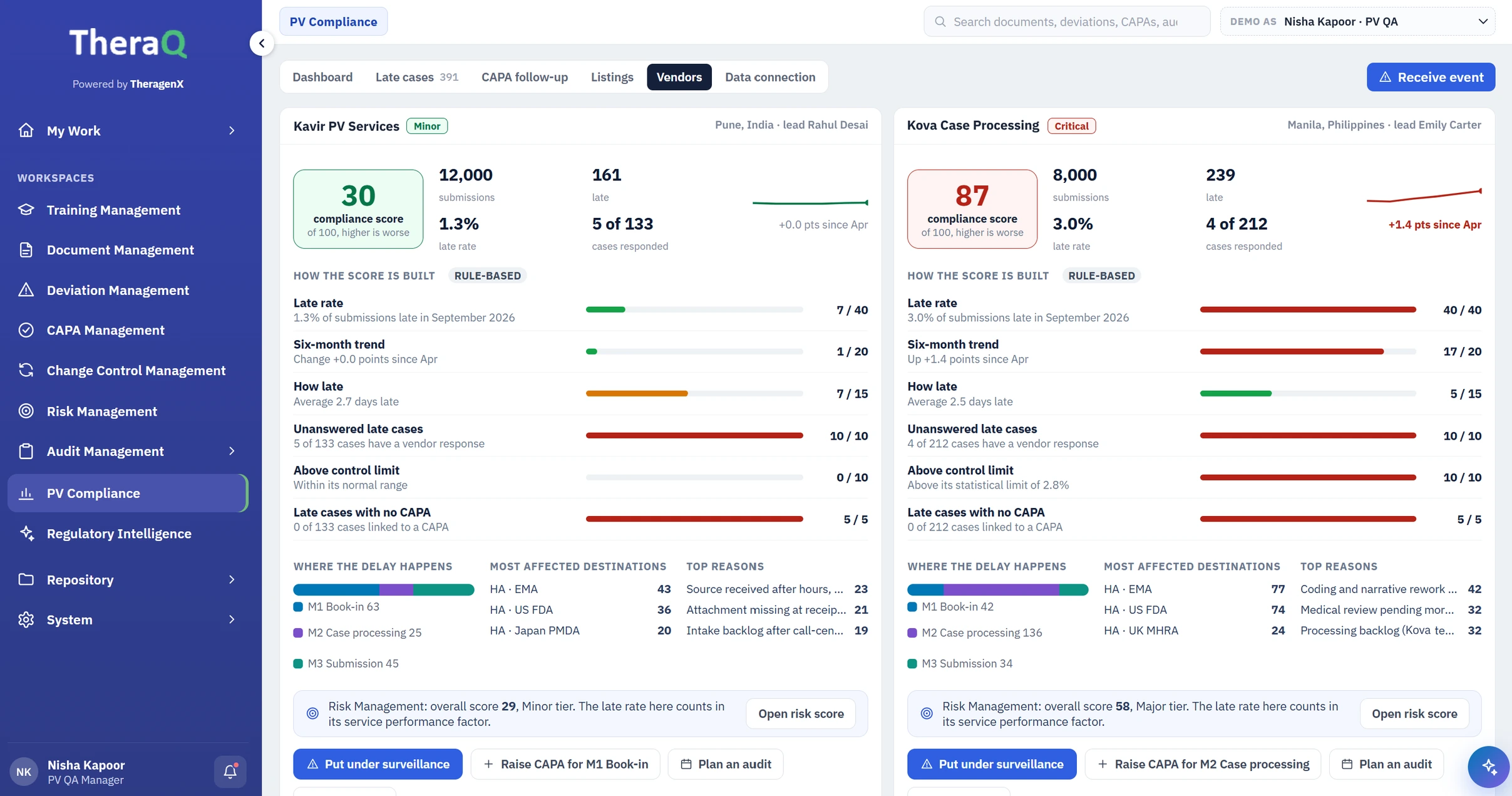
Screens from the TheraQ application, with demonstration data and fictional names.
The problem
Quality evidence is spread across too many places.
SOPs in one tool, training in another, CAPAs in spreadsheets, vendor issues in email. When an inspector asks a question, the answer becomes a search.
Audits follow the calendar
The same places are audited on a fixed cycle, while a vendor whose late rate is climbing waits its turn.
Scores nobody can explain
A vendor rating without the rules behind it cannot be defended to an inspector, or to the vendor.
Late reports found too late
Late safety reports are counted at month end, not traced to the stage where they slipped.
Actions that never close
Findings, deviations and CAPAs sit in separate lists, so nobody sees what is overdue until it is.
What customers ask to see
Five screens quality teams ask for first.
Each one answers a question a Head of Quality is asked every week.
- 1See the screen
Where to audit first
The heat map places every vendor, site and internal team by impact and likelihood, so the audit plan follows risk, not the calendar.
- 2See the screen
Plan an audit by risk
The auditee is chosen from a ranked list, and its score is explained factor by factor before anyone commits a team to it.
- 3See the screen
The audit program on one screen
Audits in progress, open findings, your own items and alerts on rising risk, so nothing waits unseen.
- 4See the screen
PV compliance, built in
Every late safety report by health authority, partner, stage and vendor, against a control limit, so a trend is caught before an inspector finds it.
- 5See the screen
Vendor scores you can defend
Each score is built rule by rule, and the next step is one click away: surveillance, a CAPA or an audit.
What it covers
Every quality process, in one connected system.
Organized around GVP Module I, ICH E6(R3) and the quality risk management of ICH Q9(R1), for quality, clinical, safety and pharmacovigilance, regulatory, medical, and the vendors and partners behind them.
Document management
SOPs, policies, work instructions, templates and forms, from drafting through QA review, function head approval and periodic review. Printed copies are marked as uncontrolled.
Training management
Curricula and assignments, e-learning, read and understood, assessments, recurrent training and overdue reminders.
Deviation management
Investigation, root cause and impact assessment for every deviation and nonconformity.
CAPA management
Root cause by five whys, fishbone, Pareto or FMEA; corrective and preventive actions; an effectiveness check.
Change control management
Change requests with an impact assessment, implementation tracking and an effectiveness check.
Risk management
Risks identified, assessed and scored, with mitigation, a risk register and periodic review.
Audit management
Internal, client, vendor and regulatory audits, their findings, and readiness for inspection.
Oversight and management review
Quality KPIs, overdue items and trends, ready for management review.
Across the system
Audit trail, electronic signatures, notifications and escalations, an AI assistant and system exceptions.
Built in for drug safety. A PV compliance workspace tracks every expedited report against its deadline, by destination, stage and vendor, and links late cases to their CAPA.
Follow one quality event
From a late report to an audit brought forward.
One vendor's late rate crosses its control limit. Every step lands in the same linked record.
The trend is detected
A vendor's late rate reaches 3.0 percent, above its control limit of 2.8 percent. PV Compliance shows the destinations affected and the stage where the cases slipped.
A deviation is raised
The late cases are attached. Quality assesses the impact on patients, compliance and data, and names an investigator.
The root cause is recorded
The investigation finds a processing backlog at the vendor's case processing stage, and records it with its evidence.
Corrective and preventive actions are set
A backlog plan is agreed with owners and due dates. The SOP change goes through change control, and training on it is assigned.
Effectiveness is checked
After the agreed period, the late rate is checked against its limit. The CAPA closes only if the result holds.
The next audit comes forward
The vendor's risk score rose with the trend, so it moves up the audit-first list and its next audit is planned with the scope the score suggests.
Illustrative example, with the fictional vendor from the screens above.
Who decides
Drafting and finding. Quality decisions stay yours.
TheraQ finds the related records, drafts for review and flags what needs attention. A qualified person classifies, approves, signs and closes, and every score shows the rules behind it.
Built to be inspected
Five controls an inspector can check for themselves.
Designed for 21 CFR Part 11 and EU Annex 11, and validated the GAMP 5 way.
- 01
A complete audit trail
Every record keeps its history: what was created, changed, approved or signed, by whom and when.
You can checkThe history of any record - 02
Electronic signatures
Each signature shows the signer's printed name, the date and time and its meaning, and is linked to its record.
You can check21 CFR 11.50 and 11.70 - 03
Notifications and escalations
Due dates and overdue items reach their owner, and escalate when they are missed.
You can checkWho was told, and when - 04
An assistant that drafts and finds
The AI assistant finds related records and drafts for review. A person approves anything that goes on the record.
You can checkThe records each draft used - 05
Scores that show how they are built
Risk and compliance scores are rule-based, and each factor and its points are shown beside the score.
You can checkEvery point, rule by rule
 ISO/IEC 27001:2022Intertek Certification Limited (UKAS 0014)
 ISO 9001:2015Intertek Certification Limited (UKAS 0014)
 SOC 2 Type IIAttestation
Ready for inspection on any day of the year. The ISO/IEC 27001:2022 and ISO 9001:2015 certificates are in the Trust Center. SOC 2 Type II attestation: the full report follows a call and a mutual NDA.
Where it connects
On its own, or joined to the work it governs.
TheraQ runs as your quality system by itself. Beside other TheragenX modules, its records link to the case, the rule or the evidence they concern.
- TheraSafeThe submissions and late cases behind PV compliance
- TheraIntelThe regulatory change that adds an item to the next audit
- TheraSureA change control that needs revalidation goes to TheraSure, and the validation records come back to TheraQ
- Your systemsOther safety and business systems, through standard interfaces
Questions
What quality leads ask.
How our evidence is shared, level by level, is set out in the Trust Center.
Is TheraQ only for pharmacovigilance?
No. TheraQ is a quality management system for the whole organization: controlled documents, training, deviations, CAPA, change control, risk, audits and inspections for every GxP function. PV compliance is one workspace inside it.
Do we need the other TheragenX modules?
No. TheraQ works on its own. The links to cases, regulatory changes and validation evidence appear when those modules are in use.
We already have a quality system. Can TheraQ work beside it?
Yes. TheraQ connects to third-party systems through standard interfaces, so it can run beside the systems you keep or replace them over time.
How are risk and compliance scores worked out?
By rules you can read. Each score is shown with its factors and their points, for example impact, likelihood and detectability for an audit risk score, so it can be explained to an auditor, an inspector or the vendor.
How do electronic signatures work?
Each signature shows the signer's printed name, the date and time, and its meaning (21 CFR 11.50), is linked to its record so it cannot be copied or removed (11.70), and is captured in the audit trail. Your validation confirms compliance in your use.
Is TheraQ validated?
It is tested and released under our quality system as part of the platform, and TheraSure gives you the evidence to validate your use. The validation package comes to customers with the signed SOW; see the Trust Center.
Request a demo
Bring your last audit finding.
We will show it raised, investigated and closed in TheraQ, and where its process would sit on your risk heat map.
- A walkthrough with our Quality team
- Your own process, on fictional data
- A reply within one business day