
TheraSentriX, signal detection and management
Signal detection and management, from statistical score to signed decision.
TheraSentriX is signal detection software: it brings public and company safety data into one model, ranks drug and event pairs with statistics you can explain to an inspector, and takes each signal through an audited review to a signed decision. AI drafts and explains; your scientists decide.
Sign in is for existing customers.
Loraxinib: events ranked for reviewEB05
The job
Authorities expect signals to be evaluated continuously. Most teams are still assembling the evidence.
- 01
Evidence sits in separate systems
Case reports, literature, public databases and trial data each live somewhere else, and each has its own export.
- 02
Scientists spend the day formatting
Highly qualified people aggregate and document, and evaluate in the time that is left.
- 03
A score with no working shown
A number nobody can reproduce is hard to defend when an inspector asks how it was reached.
- 04
Gaps in the record
When validation, assessment and sign off happen in email, the trail an inspection needs has to be rebuilt afterward.
Explainable science
Every score starts from a 2×2 table you can see.
TheraSentriX uses the standard disproportionality methods and shows the counts behind each one, so a reviewer can recompute any figure by hand.
The 2×2 table behind every score · illustrative counts
| Event of interest | All other events | |
|---|---|---|
| This product | a = 120 | b = 4,880 |
| All other products | c = 2,400 | d = 497,600 |
PRR(a ÷ (a + b)) ÷ (c ÷ (c + d))= 5.0
ROR(a × d) ÷ (b × c)= 5.1
A disproportionality score is a reason to look. It says nothing about cause, and the product says so beside the scores.
- PRR and ROR
- Proportional reporting ratio and reporting odds ratio, each with its confidence interval.
- Chi-square
- Tests whether the difference from the expected count is larger than chance would explain.
- EBGM, EB05 and EB95
- An empirical Bayes estimate shrinks scores where counts are small, which reduces false alarms. EB05 is its conservative lower bound, the one a reviewer can defend.
- Your thresholds
- For example a PRR of 2 or more with at least 3 cases and a chi-square of 4 or more (Evans 2001), tuned by product and lifecycle stage.
- Beyond the score
- Trend and time to onset, stratified analysis, concomitant medication, comparison across a class, and a check of each event against your label text.
Follow one signal
From detection to decision, every step is signed.
Every signal decision carries a named person's signature, from validation to closure.
-
Stage 1 of 6
Detection
Data is loaded, scored and flagged against your thresholds.
Written to the signal record
The counts, the four measures and the thresholds in force when the pair was flagged.
-
Stage 2 of 6
Validation
The reviewer checks whether the association is already known (label, risk plan, earlier periodic reports), whether duplicates explain the count, and whether the evidence justifies further analysis.
A named, qualified reviewer decides
Written to the signal record
The checklist as answered, and who answered it.
-
Stage 3 of 6
Prioritization
The signal manager assigns it with a priority and a deadline set by your procedures.
A named, qualified reviewer decides
Written to the signal record
The priority, the deadline and the person it was assigned to.
-
Stage 4 of 6
Assessment
The evidence is brought together and a report is drafted by AI. The reviewer weighs the Bradford Hill criteria and writes a recommendation with a rationale.
A named, qualified reviewer decides
Written to the signal record
The evidence relied on, the AI draft marked as a draft, and the reviewer's recommendation with its rationale.
-
Stage 5 of 6
Approval
The medical officer confirms or overrides the recommendation. Agreement and override are equally visible, and both are recorded.
A named, qualified reviewer decides
Written to the signal record
The confirmation or the override, signed.
-
Stage 6 of 6
Closure
The disposition is recorded: refuted, kept under monitoring, or confirmed with an action such as a label change or a risk plan update. A signal that may be an emerging safety issue is escalated at once under your procedure.
A named, qualified reviewer decides
Written to the signal record
The disposition and its link to the periodic report. After this the record is locked.
See it
From a portfolio at a glance to one drug, one signal and a signed decision.
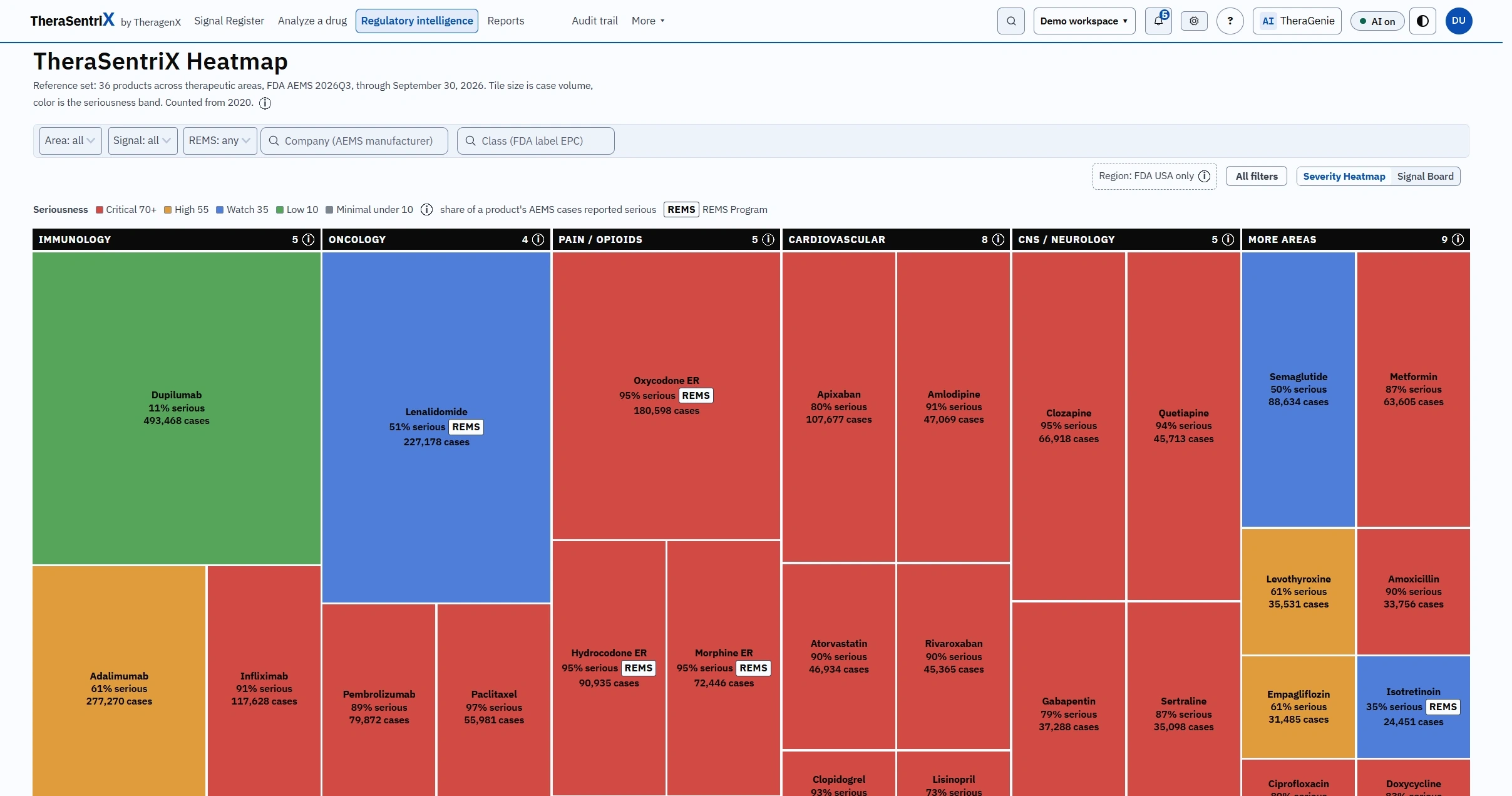
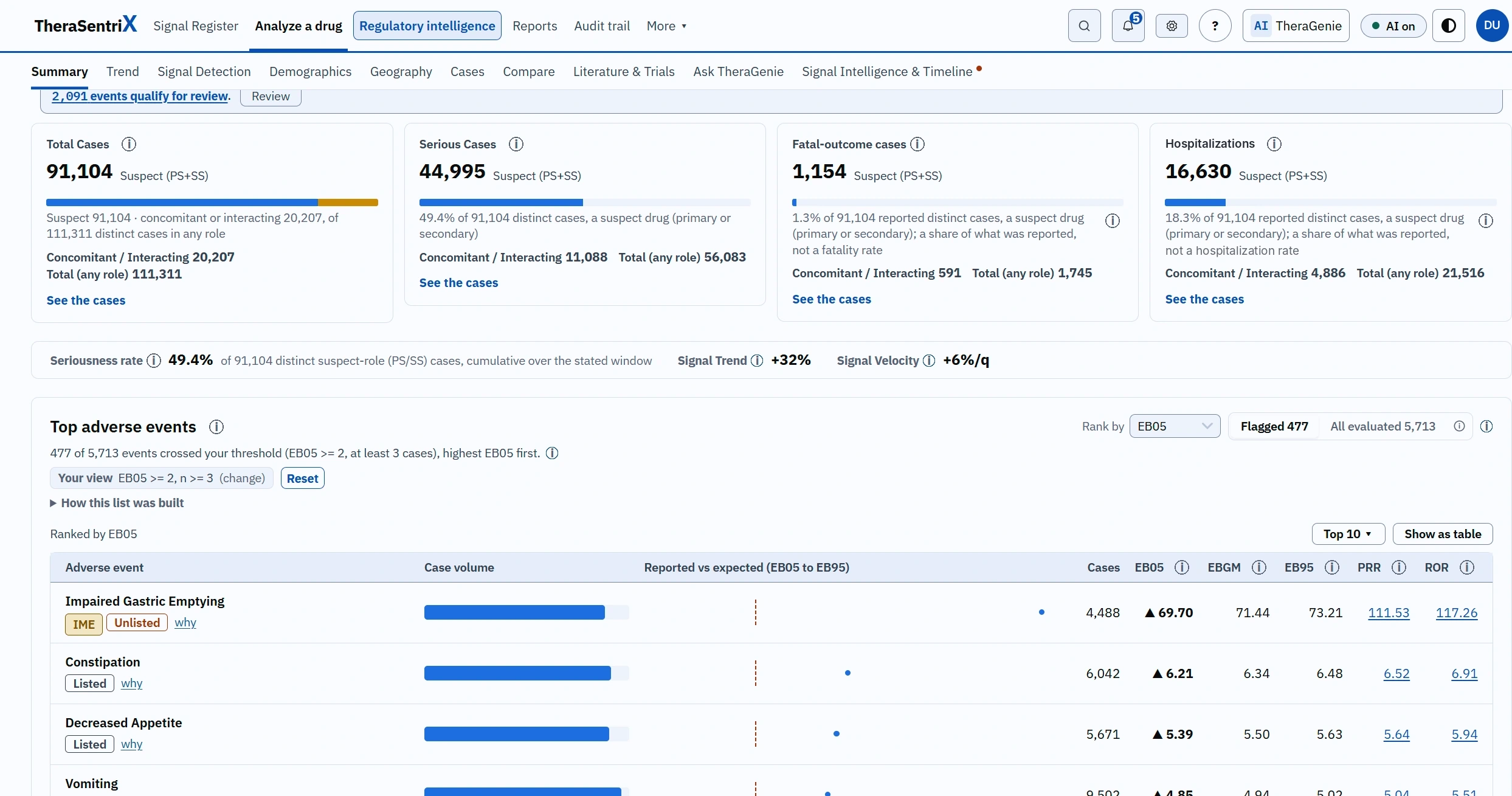
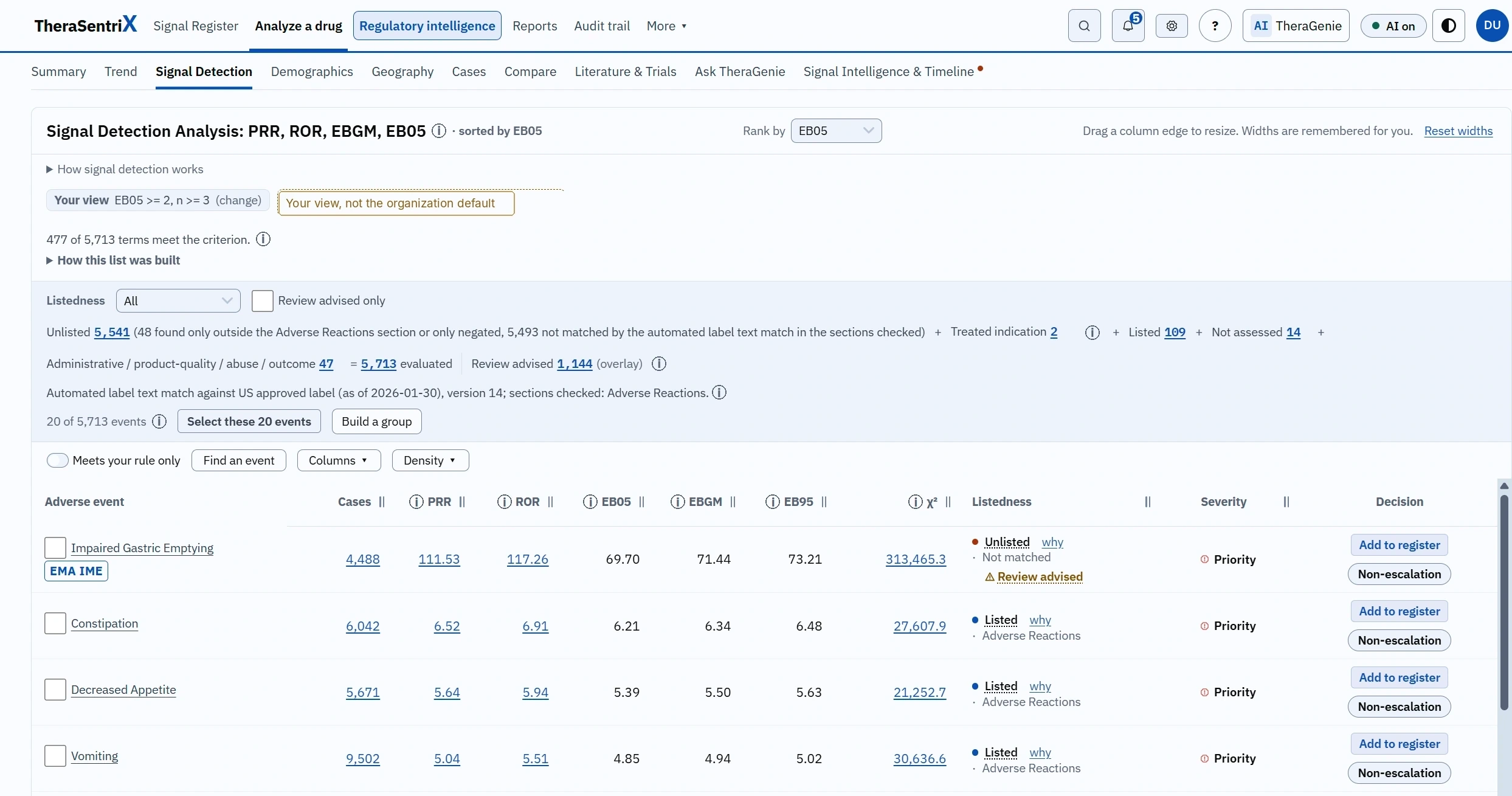
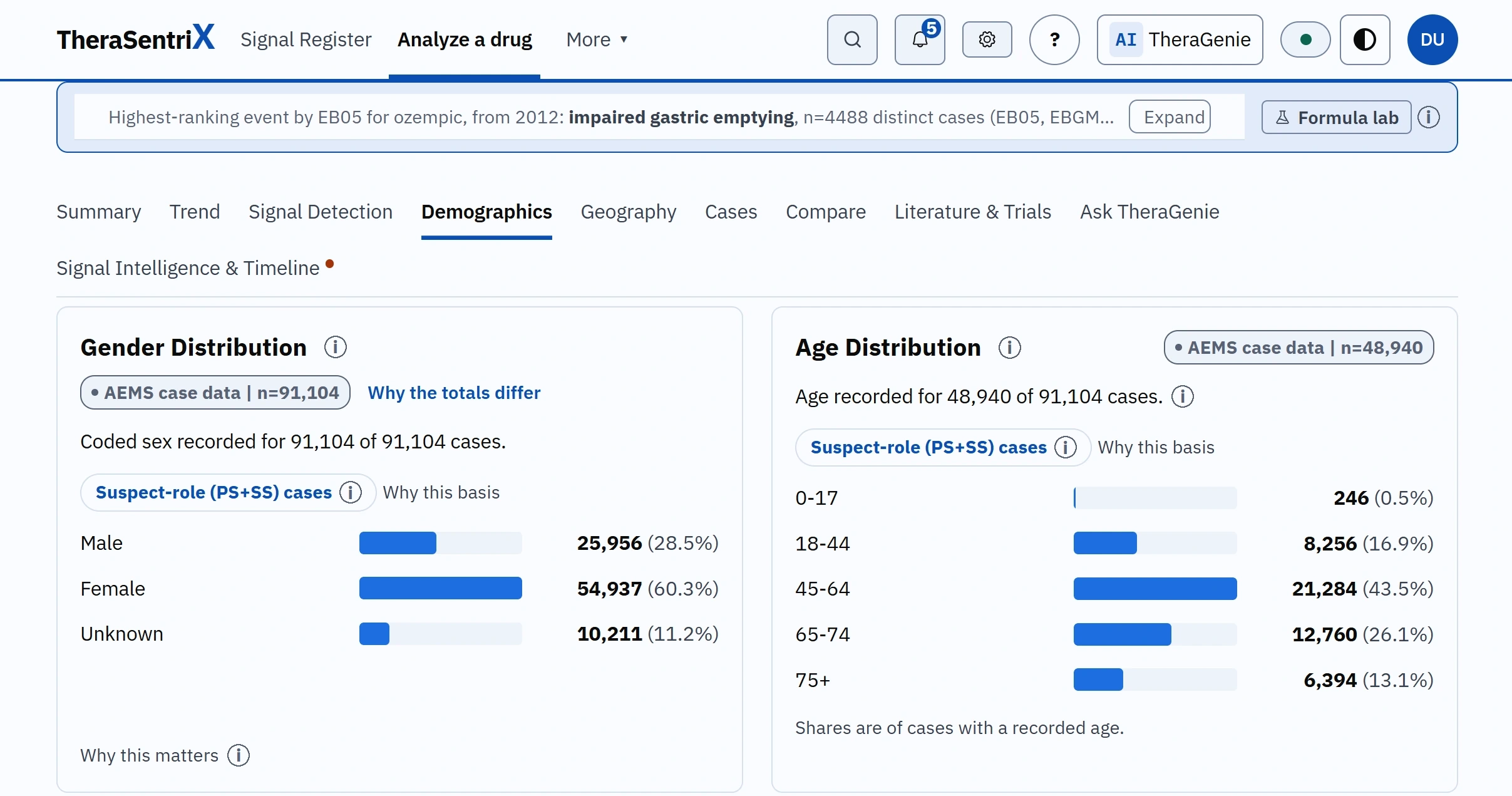
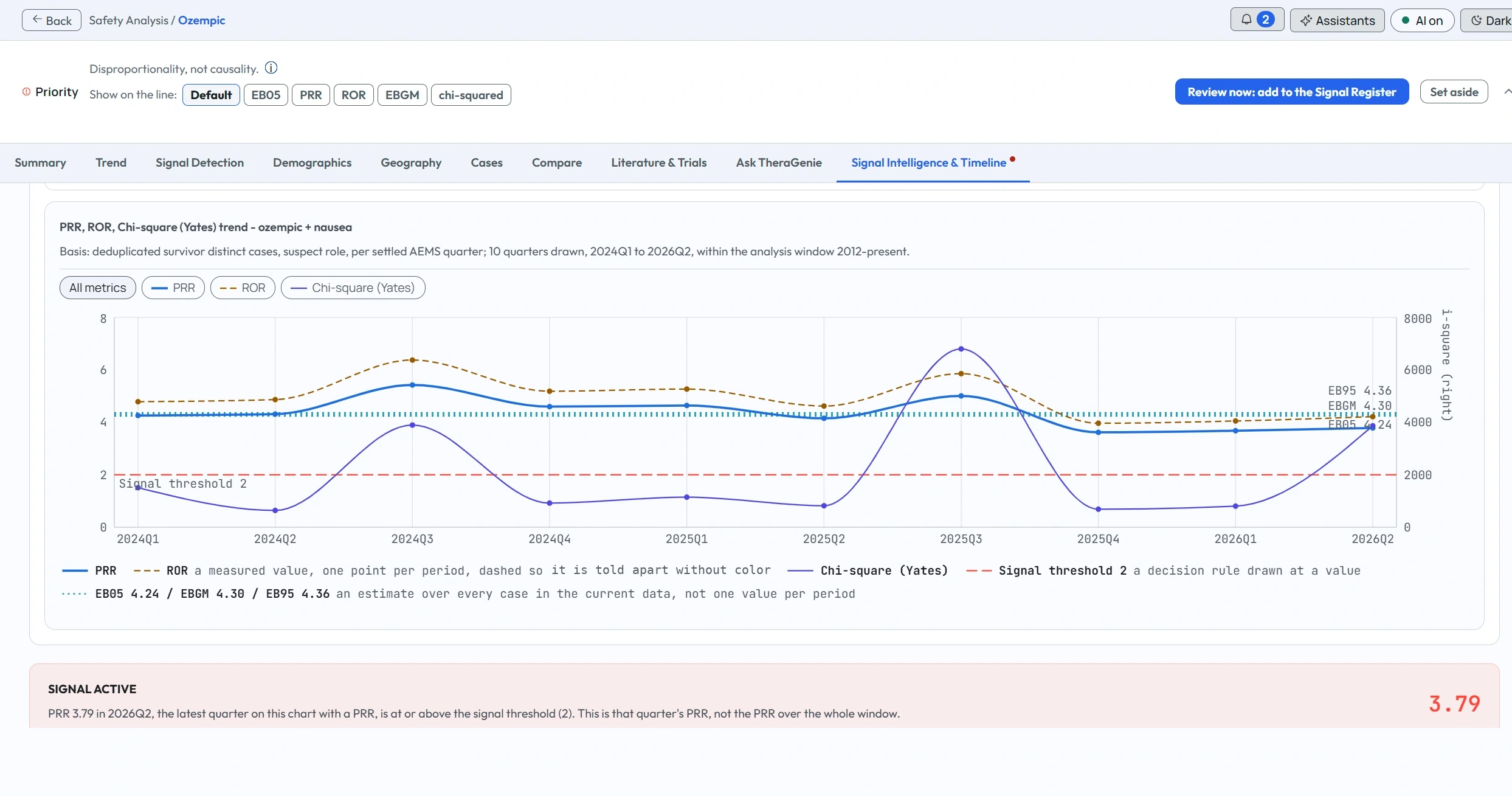
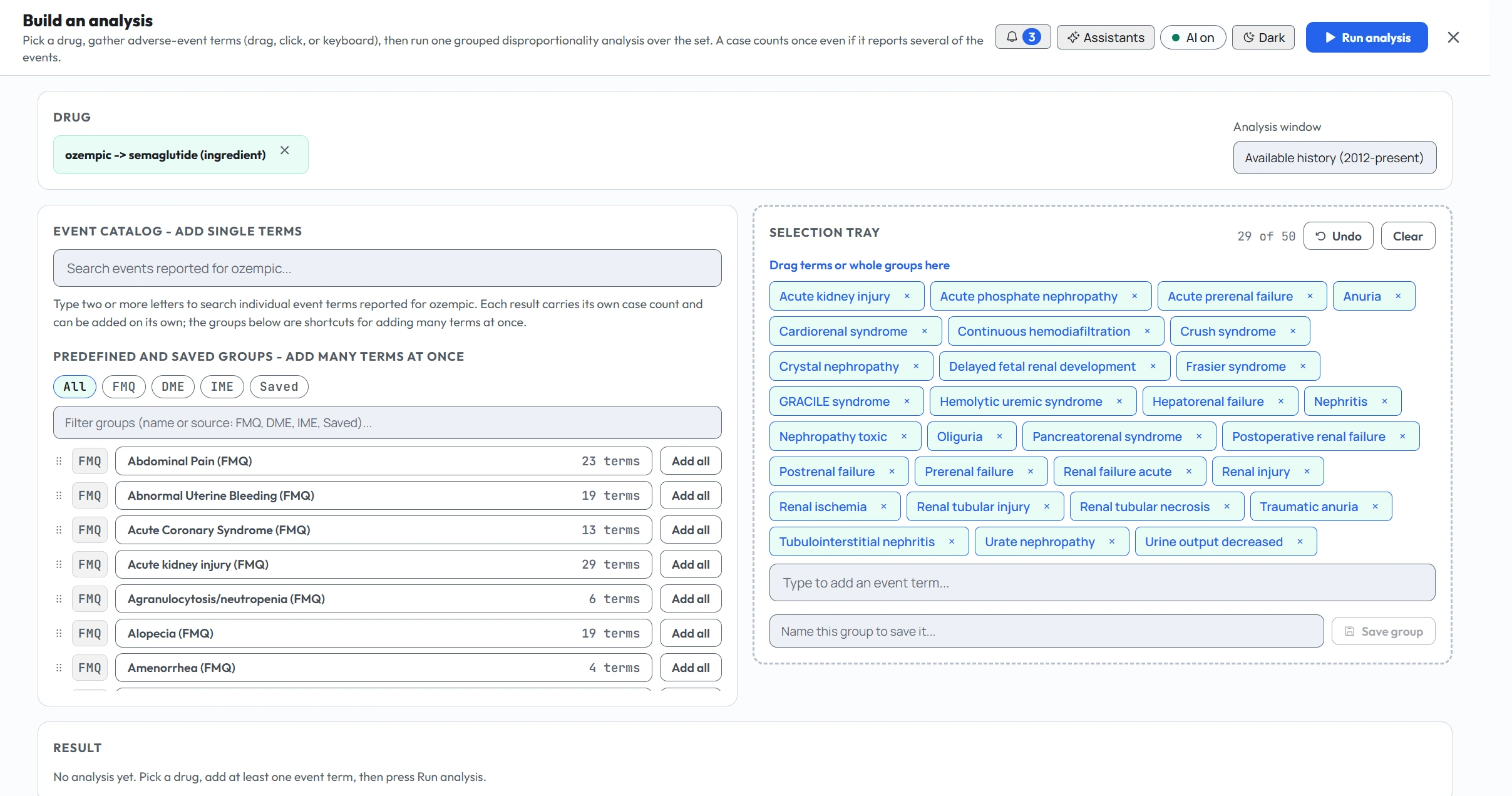
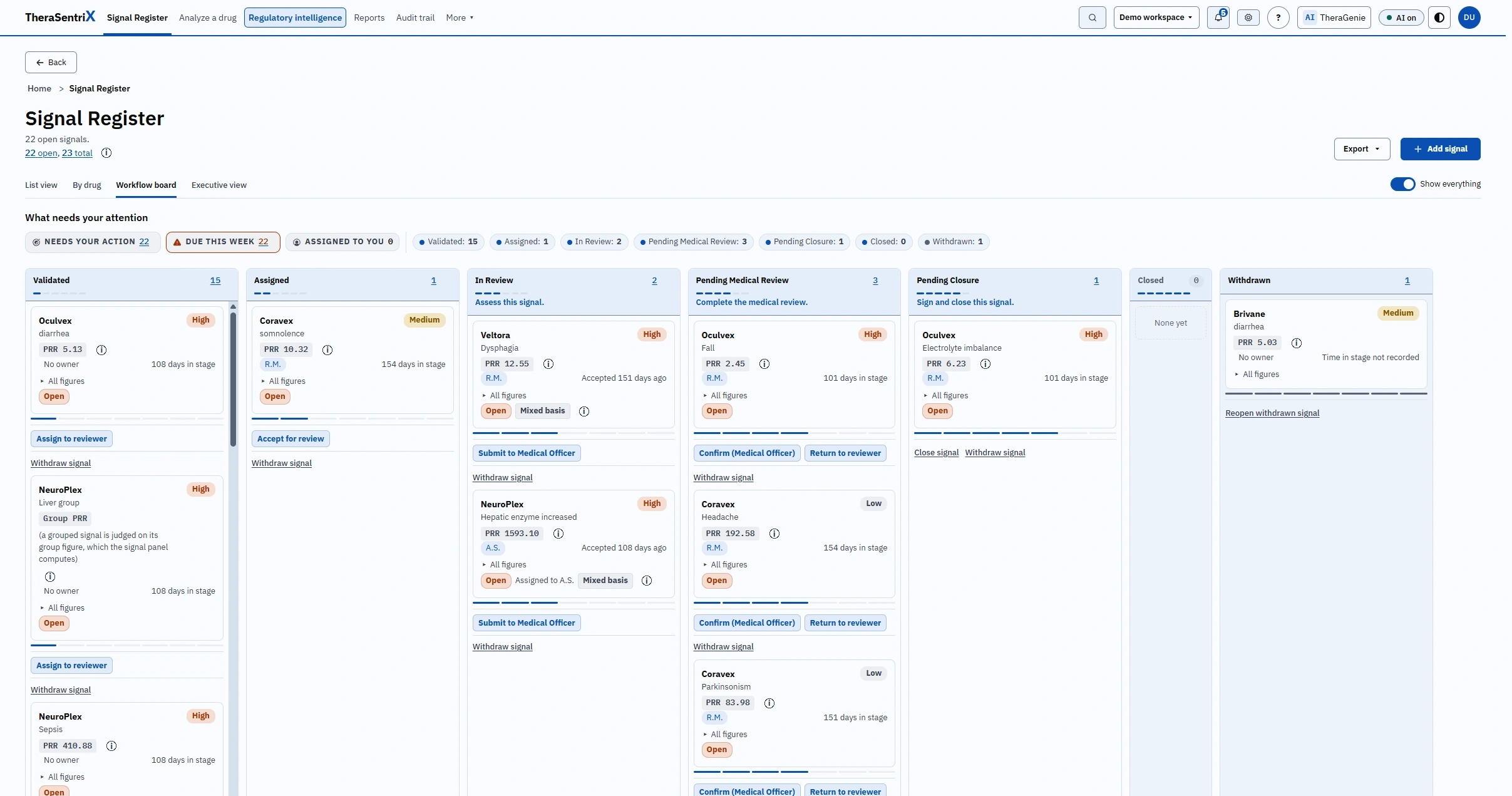
All seven screens are from the TheraSentriX application.
Product screens show public FDA adverse event data (FDA AEMS) and a demonstration workspace; product names in workflow screens are fictional. Color on the map shows the share of a product's reports marked serious, which reflects who reports, not how dangerous a medicine is. A report does not show that a medicine caused an event.
Who does what
Three roles, one record.
Before a reviewer opens it
TheraSentriX
- Loads the public data and the sources you hold access to into one model
- Computes PRR, ROR, chi-square and EBGM for each drug and event pair
- Flags the pairs that meet your thresholds
- Checks each event against your label text
- Drafts the assessment report, marked as a draft, with links to the evidence it relied on
Decisions for your expert
A named, qualified reviewer decides
- Signal reviewer. Works the clinical checklist, weighs the Bradford Hill criteria and writes a recommendation with a rationale.
- Signal manager. Assigns each signal with a priority and a deadline set by your procedures. Records the disposition and locks it at the end.
- Medical officer. Confirms or overrides the recommendation. Agreement and override are equally visible, and both are recorded.
What leaves
A signed disposition
- The disposition, linked to the periodic report
- The signal record, with every stage and signature
- Signal outcomes that feed the review of your reference safety information
- Nothing is submitted to an authority without human sign off
AI and its limits
AI writes the first draft of the words. People own the conclusion.
An AI summary points to the cases, articles and figures it relied on, and explains how it reached its view, so a scientist can disagree with a specific step. It is marked as a draft until a named person has reviewed it. Prompts and model versions are recorded and change only through change control.
Arrived from a drug page?
The drug pages on this site show a summary. TheraSentriX is the system behind them.
| On the drug page | In TheraSentriX | |
|---|---|---|
| Data | FDA's public adverse event reports | FDA data plus your safety database and the sources you hold access to |
| Refresh | Every quarter | As each source publishes, and as your own cases arrive |
| Statistics | PRR, ROR and EBGM with EB05 and EB95, at one fixed threshold | The same measures plus chi-square, at thresholds you set by product, with stratified and trend analysis |
| Scope | One drug at a time | Your whole portfolio, with comparison across a class |
| What happens next | Nothing. It is a summary. | Each signal assigned, assessed, decided and signed |
A report does not show that the medicine caused the event. Neither does a disproportionality score. Back to Check your drug
Where it connects
TheraSentriX sits above your safety systems, or inside TheragenX.
- Public and licensed sourcesFDA AEMS (formerly FAERS), built in. EudraVigilance (EVDAS), WHO VigiBase, the MHRA Yellow Card, Canada Vigilance, Japan's public adverse reaction data (PMDA), clinical trial and real-world data under your own access rights
- Your safety databaseYour own cases, as they arrive
- TheraSafeCase line listings and periodic report inputs
- TheraLitPotential signals and clusters from the literature
TheraSentriX
- Your periodic reportsEach closed signal is linked to the report it belongs in
- Your reference safety informationSignal outcomes feed its review
TheraIntel brings safety communications and label changes for the same products.
 ISO/IEC 27001:2022Intertek Certification Limited (UKAS 0014)
 ISO 9001:2015Intertek Certification Limited (UKAS 0014)
 SOC 2 Type IIAttestation
Every module uses standard interfaces: TheraSafe exchanges E2B(R3) with authorities and partners, and every module can exchange data with your safety database and other systems. Designed for 21 CFR Part 11 and EU Annex 11. Validated the GAMP 5 way. Certificates and their scope are in the Trust Center.
Questions
What signal teams ask about TheraSentriX.
How your data is hosted, kept apart and never used to train models is answered once, in the Trust Center. How the AI is checked is in How it is built.
Does a high score mean the drug caused the event?
No. Disproportionality shows that an event is reported more often with a product than expected. It is a reason to review the cases. Causality is a clinical judgment made in the assessment stage and signed by a person.
Which data sources can it use?
FDA AEMS (formerly FAERS) is built in. Your safety database, EudraVigilance (EVDAS), WHO VigiBase, the MHRA Yellow Card, Canada Vigilance, Japan's public adverse reaction data (PMDA), literature, clinical trial and real-world data can be added, each under your own access rights.
Can one service provider run several sponsors on it?
Yes. It is one platform, released under change control and configured for each sponsor: each sponsor's rules, thresholds and workflow are settings, and every sponsor's data, rules and audit history are kept apart from every other sponsor's. It runs in our cloud, your cloud or your own data center, hosted in the region you choose. Going live follows five steps: scoping, configuration, qualification and user acceptance, training with a parallel run, then hypercare.
Request a demo
Pick a product class. We will show you its signals, with the working.
A live walkthrough on FDA public data for products like yours: a ranked table, one signal registered, assessed and signed.
- Live public data, your product class
- Every score recomputed from its counts in front of you
- A reply within one business day